


What does it mean to be of a place? Of the sun and soil and bees, of the river and black ants and cowpeas? To be so entangled with an ecosystem, generation after generation, that nature and culture become one?
Clans in Tharaka, Kenya, have been subjected to colonialism and all that followed. But Atharaka – ‘those of Tharaka’ – are remembering the strength in this identity. Beside the Kithino River, they are creating the conditions for customs and ecology to bounce back: reviving a complex indigenous relationship with place that brings balance, autonomy and joy.
Following the community’s streams of work to restore their seed, kin and spirit, this film bears witness as elders and Earth recall who Atharaka are, and where they belong.
This film was magicked into being by artist Andy Pilsbury. It features the work of African Earth Jurisprudence Collective founding member, the Society for Alternative Learning and Transformation (SALT), in collaboration with Collective co-founders, The Gaia Foundation.
“THIS IS THE STORY OF REVIVING OUR RIVER OF LIFE”
“A river can teach us many things. Like water, we flow forward. But there are rocks. We must find a way around these obstacles and, sometimes, the water must go all the way back before flowing forwards again.” Simon Mitambo

When Simon Mitambo trained as an Earth Jurisprudence Practitioner with Gaia, he made a commitment to return to his childhood river, Kithino.
This training transformed his perspective from human-centred to Earth-centred, guided by the philosophy of Earth Jurisprudence and inspired by indigenous cosmologies that have recognised nature as their primary text for millennia.

Every day, Simon walked barefoot to Kithino’s banks. He grew to know the river as he grew to know the community who care for her: the people of Tharaka whose ancestors’ footprints still surface in the silt from time to time.
Having graduated and joined the African Earth Jurisprudence Collective, Simon brought his community together in elder-centred dialogues. Accompanied by SALT, they began to remember their pre-colonial knowledge, of the reciprocal relationship between people and place that enables all to flourish.
SEED
“A seed means both this millet, our goats and one’s children. All grow from this land. That is our relationship.” Salome Gatumi, Seed Custodian and Elder of Tharaka

In telling us the story of seed, elder Salome tells us the story of everything. From farming’s origin on a riverbank, where a family worked with wild millet, to the present-day domination of hybrid seeds, sold together with the chemicals they are bred to depend on.
A few handfuls of indigenous seed were kept safe by custodians like Salome as industrial farming swept across Africa, driving the adoption of genetically modified crops, chemicals and corporate seed laws. Salome’s ancestral varieties are now being resown in the soil from which they came. Traditional seeds, grown organically, are resilient to climate chaos, sacred to cultural ceremonies, and nutritious to an entire ecosystem whether eaten by human, bird or bee.
“We live in the land of the sun. Even when there is not enough rain due to climate change, seeds from Tharaka still flourish and we have a harvest.” Salomi Gatumi
And so seeds pass from woman to woman once again, between Mother Earth and elders in a song so strong that, by reviving one seed, they revive all.
KIN
“Traditionally, we grazed goats in a rotational system that allowed the land to rest. Now, people graze their own animals on private property. When our communal lands were divided by colonisers, our people were divided too. This breakdown in trust has caused conflict in our communities. Working communally again brings unity, love and coexistence. Goats were in trouble, but they are central to life here. Our goats make us ‘Atharaka’: ‘people of Tharaka’” Mbura M’Rugia, Elder of Tharaka

Dismantling the barriers between land, animals and people imposed by the colonial drive for ownership, elders Mbura and Mutegi are returning to the grazing methods they learnt from their fathers.
Goats are culturally important to Tharaka’s clans. Their milk was traditionally used to make a kind of porridge that sustained people through periods of hunger, and they are revered as symbols of purity which makes them important for rituals.
When goats graze together, every kid is born stronger due to genetic diversity and the joy of living life as part of a herd. When those herds follow a rotational system, every foothill flourishes through a cycle of rest and regeneration. When neighbours unite to create that system, conflict is healed by their common vision for a future of shared abundance.

SPIRIT
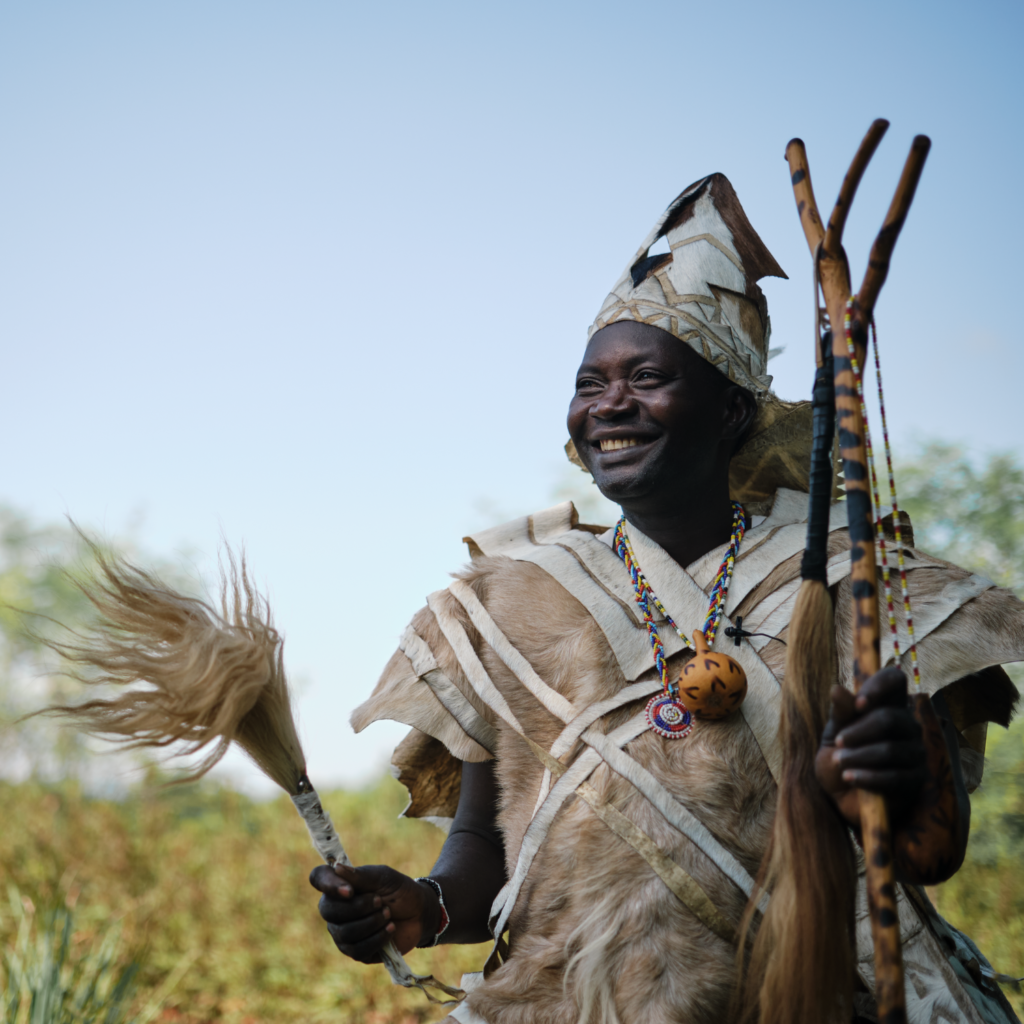
“Sacred Natural Sites are where we can be united with our ancestors and nature, to restore balance between us. The strength of our spirit inspires young people to learn. Once they understand Sacred Natural Sites, they protect them.” Gitongo Chabari, Young Mugwe, the Spiritual Leader of Tharaka
When the Tharaka people were born into their ancestral lands of eastern Kenya, they found Sacred Natural Sites. Here, the veil between humans, ancestors and nature is thin. Rituals performed in such potent places restore equilibrium, sustaining balance across all the territory.


They are cared for by Sacred Natural Site custodians and remain at the heart of customary ecological governance, as no-go zones for any disturbance including hunting, grazing, deforestation, or mining – an ancient, indigenous form of conservation.
The spiritual leader who accompanies these custodians is called Mugwe: a role passed from father to son and still active today.

THOSE OF THARAKA
“These are not ideas imposed on us from outside: they spring from a deep well of wisdom that our elders are remembering and passing on to the next generation – so that young people of Tharaka have a resilient and beautiful home, long into the future.” Simon Mitambo

Renewed pride in these past traditions has brought courage for future ambitions, to restore Tharaka’s biocultural coherence. The film accompanies Brennie, a young person of Tharaka and Earth Jurisprudence Trainee, as she learns the wisdom of her elders according to the indigenous process of intergenerational learning.
Inspired by Kithino, the community have mapped their own River of Life. It is formed from streams of work they are undertaking to revive their ancestral seed, kin and spirit. Each stream turns back in order to flow forwards again, looking to the past as potential for a climate resilient, autonomous future.

